
Human Enhancement
What Do We Worship, What is our Devotion?
By Chris "Yellow Owl" Albaugh
One of the recurring conversations throughout my life has been about what we choose to invest in.
Whether I was speaking at an event or with a family member, a friend, a financial advisor, or someone interested in supporting our work, the conversation almost always returned to money. Again and again, I was encouraged to invest in corporations, markets, and financial instruments that promised greater returns.
My response was almost always the same.
"I'd rather invest in people."
"I'd rather invest in the planet."
That answer often confused people.
It wasn't because I rejected financial prosperity.
Nor did I believe business itself was the problem. Business can become one of humanity's greatest expressions of service when it creates more value than it extracts, strengthens relationships rather than exploiting them, and leaves people and places healthier because it existed.
What I struggled to understand was why we so often measured success by accumulation while overlooking the condition of the people, communities, and ecosystems that made that success possible.
Many conversations with potential investors in our ecosystem and community eventually arrives at the same crossroads.
The measurement.
For many, success was measured by revenue, profit, valuation, market share, and return on investment.
Those measurements have their place.
They tell part of the story.
But they are not the whole story.
I often found myself asking different questions.
How healthy are the people we serve?
How healthy are the people doing the serving?
Do families become stronger because of this work?
Does the land become healthier?
Do our rivers run cleaner?
Do people leave with more hope than when they arrived?
If an organization becomes wealthier while its people become exhausted, disconnected, or unhealthy, what have we truly gained?
Perhaps we have confused financial growth with human flourishing.
Money is currency.
But currency is more than paper, coins, or numbers on a screen.
Currency is anything that flows.
Time is currency.
Attention is currency.
Energy is currency.
Trust is currency.
Presence is currency.
Knowledge is currency.
Love is currency.
Money simply gives us one way to exchange value.
The deeper question is what we value enough to exchange our lives for.
Because that is exactly what we are doing.
Every hour we work.
Every relationship we cultivate and maintain.
Every dream we postpone or take the leap towards.
Every promise we keep and don't.
Every opportunity we embrace and those reject.
We are exchanging pieces of our life for something we believe is worthy of our devotion towards a future life.
The value we place on money quietly shapes the boundaries of our being.
It influences how we relate to security and uncertainty.
To scarcity and excess.
To fear and generosity.
To comfort and purpose.
There are seasons when survival is wisdom.
There are seasons when paying the bills is an act of love.
There is dignity in providing for ourselves and those entrusted to our care.
Yet somewhere along the way many of us stop asking whether we are making a living and forget to ask whether we are truly living.
Will we invest our time, our purpose, and our passion because they are our calling or are we attempting just to exist?
Or will we devote ourselves to them, but only to what provides comfort, convenience, and the appearance of security?
Neither answer is the same for everyone.
But the question belongs to all of us.
As I've traveled to different parts of the world, one observation has quietly followed me.
No matter the country, the language, or the culture, some of the most elaborate, enduring, and carefully maintained buildings often belonged to two kinds of institutions.
Religions.
And banks.
I find that fascinating.
One is entrusted with what many consider our spiritual wealth.
The other with our financial wealth.
Both ask us to place our trust in something beyond ourselves, beyond just our being human.
Both invite us to invest.
Both become places we return to throughout our lives for salvation, certainty and clarity.
This isn't a criticism.
It's an observation.
What does the way we build reveal about what we value?
When a civilization dedicates its greatest craftsmanship, resources, and generations of labor toward certain structures, those buildings become mirrors.
Mirrors reflecting what a culture believes is worthy of protection, devotion, and investment.
Yet the teachings that have touched me most whether from Jesus, the Buddha, indigenous elders, or countless ordinary people whose lives quietly transformed others rarely centered on buildings.
They centered on relationships.
Feed the hungry.
Welcome the stranger.
Care for the sick.
Forgive.
Walk humbly.
Love your neighbor.
Share what you have.
Serve without expecting repayment.
These are not merely religious ideas.
They are deeply human practices.
More than once someone has smiled and said to me, "You're too much like Jesus, you care too much."
The irony has always made me laugh.
I don't consider myself a religious person.
Yet many of the people saying those words faithfully attended a church.
That never caused me to judge them.
It made me curious.
If someone truly believes that another human embodied compassion, courage, humility, forgiveness, generosity, and unconditional love, why wouldn't we desire to practice those same qualities ourselves?
Not to become that person.
Not to wear their identity.
But to embody the principles they lived.
Perhaps every great teacher has always been pointing beyond themselves.
Not saying, "Look at me."
But asking, "Will you participate as I have participated?"
Yesterday I was talking with my dad about these very things.
I smiled and said, "It's interesting. We're talking about the same principle of service, yet the language we use to justify that service is different."
He replied, "We just see things differently."
I laughed.
"That's exactly what I'm talking about."
We were using many of the same words.
Service.
Success.
Investment.
Responsibility.
Love.
Yet those words pointed toward different realities because our experiences had given them different meanings.
Language is a bridge.
It is never the destination.
Every word is an attempt to express something that cannot be fully contained by language.
Life always arrives first.
Language follows behind, trying to explain what has already been experienced and how to move forward.
The map is never the walk.
We've all participated in experiences where another human either deepened our experience or diminished it in a particular moment of life.
Some welcomed us so completely that we remembered who we were beyond the peaks and valleys we've explored.
Others left us carrying disappointment, grief, confusion, hurt or betrayal.
Both became teachers.
Many people have told me I have a welcoming presence and a loving heart.
I receive those words with gratitude.
Yet alongside love, life continually introduced another teacher.
Discernment.
Learning who, what, why, when, and how to invest my energy has become one of the greatest lessons of my life.
Not because everyone deserves less love, time or energy.
But because every relationship asks something different of us.
Love without discernment becomes depletion.
Discernment without love becomes judgment.
Together they become right relationship.
Perhaps this is what every institution, every business, every religion, every family, and every human life is continually asking us to remember.
Does this exist to serve life?
Or has life become devoted to serving it?
The irony is that many of the possessions we believe we own slowly begin to own us.
We devote our time to maintaining them.
Our thoughts to protecting them.
Our identity to displaying them.
Our freedom to paying for them.
Instead of investing in life, we begin investing our life into things that cannot love us back.
In the end, every investment is an act of devotion.
Every calendar entry.
Every dollar spent.
Every conversation.
Every relationship.
Every promise.
Every moment of attention.
They all reveal what we believe is worthy of our life.
Perhaps the greatest cathedral we will ever build is not made of stone.
Perhaps it is built in the way we welcome a stranger.
The way we care for a child.
The way we forgive an old wound.
The way we steward the earth beneath our feet.
The way we choose presence over performance.
The way we leave another human being more whole because they walked beside us.
Because when our final breath arrives, I doubt we will be asking how much we accumulated.
I believe a far gentler question will remain.
What did my life help flourish?
For perhaps that has always been the truest measure of wealth.
Not what we possessed.
But what we participated in bringing to life.
Perhaps beneath all of our searching lies one quiet question.
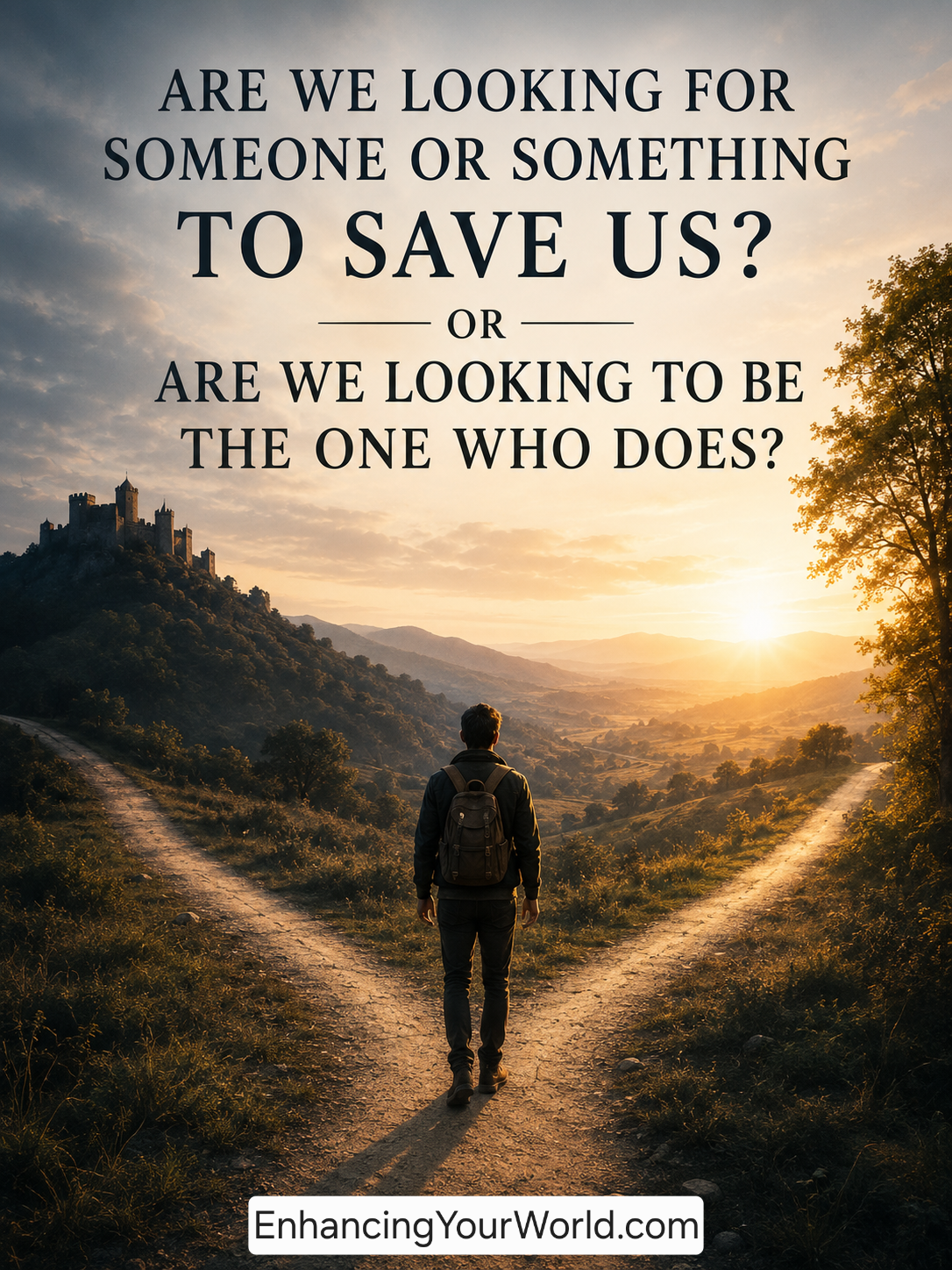
Are we looking for someone or something to save us?
Or are we becoming someone who participates in bringing healing, hope, and restoration wherever we walk?
Throughout history we have searched for saviors.
A new leader.
A new government.
A new religion.
A new technology.
A new investment.
A new job.
A new relationship.
A new program.
A new Earth
A new solution that promises to remove the discomfort of being human.
Yet every generation eventually discovers that no person, institution, ideology, or possession can live our life for us.
They may inspire us.
Guide us.
Support us.
Walk beside us.
But they cannot participate in our life on our behalf.
Perhaps the invitation has never been to wait for someone else to rescue or reconcile with us.
Perhaps it has always been to become a participant in the restoration of life itself.
To become the neighbor who shows up.
The stranger who welcomes.
The organization that serves.
The parent who listens.
The friend who forgives.
The leader who stewards.
The human who leaves every place a little more whole than they found it.
Maybe salvation is not only something we hope to receive.
Maybe it is also something we practice giving through the way we love, serve, and relate to ourselves, each other and our planet.
Not because we alone can save the world.
No one person can.
But because every act of compassion, every moment of courage, every expression of generosity, and every choice to participate consciously becomes part of the restoration we long to experience ourselves.
Perhaps that is the invitation.
Not to ask, "Who is going to save me or who will do this for me, how will this serve me?"
But to ask,
"How can I participate in bringing more life, more love, and more wholeness into this moment?"
For the world may not be transformed all at once.
But every life it touches can be.